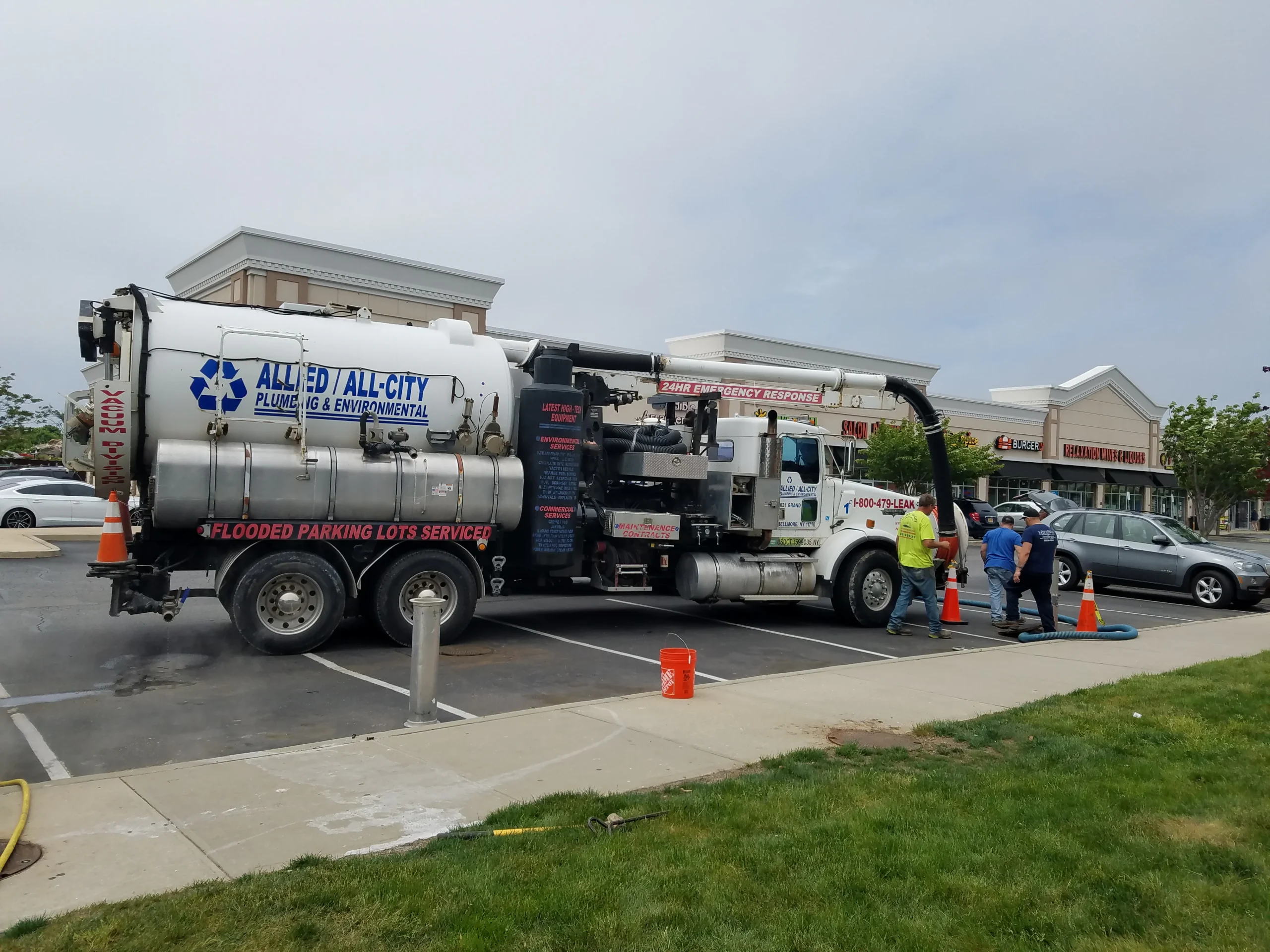
Allied All-City uses professional-grade high-pressure water jetting to restore full flow to drain lines and sewer pipes throughout Nassau and Suffolk Counties.
We never use subcontractors. Our own trained technicians handle every jetting job, giving you consistent quality and accountability every time.
Blocked drains and sewer backups don't wait for morning. We respond to emergency jetting calls any time, day or night.
Certified to work in Nassau and Suffolk Counties, including on municipal, commercial, and industrial piping systems where proper licensing is required.
We've cleared every type of blockage Long Island pipes produce — grease, root intrusion, mineral scale, and compacted debris — for years.
High velocity jetting restores pipes to near-original flow capacity, eliminating the buildup and debris that cause repeated blockages and slow drains.
Every benefit above is delivered on every job we take.
Get a Free QuoteOur licensed crew serves Nassau and Suffolk County with same-day availability and transparent pricing on every job.
We evaluate the pipe condition, blockage type, and access points to select the right nozzle and pressure setting for the job.
Pressurized water scours the pipe walls and drives all accumulated material — grease, scale, roots, debris — through and out.
We verify restored flow after jetting and can follow up with a camera inspection to confirm the pipe interior is clear and intact.
This is a fair and important question. High-pressure jetting is very effective, but the pressure settings and nozzle type need to be matched to the condition and material of the pipe. Newer PVC and ABS pipe can handle jetting without issue. Cast iron, which is common in older Long Island homes, can also be jetted safely when it's still in reasonable structural condition. However, if cast iron is severely corroded or has sections that are compromised, jetting at full pressure could cause problems. That's why Allied All-City assesses the pipe before we start. If we have any concerns about pipe condition, we'll discuss them with you and may recommend a camera inspection before proceeding. We're not going to jet a pipe that isn't suitable for it.
A drain snake is a rotating cable that's fed into the pipe to physically break through or grab a clog. It's effective at creating an opening so water can flow again, but it doesn't clean the pipe walls. The grease, scale, and residual material that built up over time stays in place after snaking, which is why the same drain often clogs again within a few months. High velocity water jetting sends pressurized water into the pipe through a nozzle that sprays in multiple directions — forward to cut through blockages and backward to push material out and scrub the pipe walls clean. The pipe comes out of the jetting process significantly cleaner, which means longer-lasting results and fewer service calls over time.
For commercial kitchens, restaurants, and food service operations, the typical recommendation is quarterly jetting of grease-carrying drain lines. Some high-volume operations benefit from more frequent service. The right interval depends on how much grease your operation generates and how your drains are performing between services. If you're seeing slow drains within two or three months of cleaning, that's a sign the interval needs to be shortened. Many commercial property owners on Long Island schedule jetting as part of a routine maintenance agreement so they're never caught off guard by a backup during service hours. Allied All-City can help you develop a schedule that fits your operation.
Yes. Root intrusion is one of the most common sewer line problems on Long Island, particularly in neighborhoods with older trees and aging clay or cast iron lateral pipes. Tree roots are naturally drawn to the moisture and nutrients inside sewer pipes, and they find their way in through small cracks or loose joints. High-velocity jetting with a root-cutting nozzle can shear roots and flush them out of the line, restoring flow. However, it's worth knowing that jetting removes the roots without eliminating the underlying entry point — the crack or joint where they got in. We typically recommend following root jetting with a camera inspection to assess the pipe condition and discuss whether any repair is needed to prevent re-entry.
Allied All-City's jetting equipment handles a range of pipe diameters — from typical residential drain lines of two to four inches up through larger commercial and municipal sewer mains. We carry multiple nozzle types suited for different blockage types: standard flushing nozzles for grease and sediment, penetrating nozzles for tough compacted material, and root-cutting nozzles for tree root intrusion. The appropriate setup depends on the pipe size, material, and what's causing the restriction. When you call us, we'll ask about the type of drain and the nature of the problem to make sure we show up with the right equipment for your specific situation.
Jetting is performed on drain lines leading to a grease trap or septic system — not on the trap or tank itself. Done correctly, jetting the inlet lines actually benefits these systems by ensuring that material reaches them in a flushed, broken-down state rather than as a partially solid blockage. Grease traps themselves can be cleaned separately, which is a different service from drain jetting. As for septic and cesspool systems, jetting the inlet line should not disturb the system as long as it's performed by technicians who understand the downstream connection. Allied All-City handles both drain jetting and cesspool service, so we can coordinate these services without creating conflicts between the two.